

A TruckClub™ resource, supported by TruckProtect™ insights, to help you protect hard‑working service, delivery, and utility trucks from costly breakdowns.
Commercial trucks are the backbone of a lot of businesses, contractors, electricians, HVAC companies, delivery operators, service fleets, utilities, municipalities, and more. These vehicles don’t just commute; they work. They haul tools and materials, power PTO systems, sit idling on job sites, and run short, stop‑and‑go routes all day.
That kind of duty cycle creates a perfect storm: heavy wear, high heat, constant vibration, and a lot of idling. Over time, that leads to expensive failures in engines, emissions systems, electrical components, and cooling systems.
That’s why “commercial truck warranty” is such an important topic.When a single Class 3–7 truck goes down, it doesn’t just generate a repair bill, it can throw off schedules, delay jobs, and impact customer relationships.This guide breaks down how commercial truck warranties work, what they typically cover, where work trucks tend to fail, and how protection plans (including TruckProtect™) can help keep your operation moving.
A commercial truck warranty is a protection plan that helps pay for repairs on major components when they fail. For Class 3–7 work trucks, that usually includes systems like the engine, transmission, aftertreatment/emissions, electrical and electronic components, cooling, and drivetrain. What makes commercial trucks different from passenger vehicles is how they’re used. They see:
All of that accelerates wear. A warranty or protection plan doesn’t stop parts from failing, but it can dramatically reduce the financial hit when they do.
Here, “commercial trucks” means Class 3–8 work trucks, highway tractors. Think about the trucks you see in neighborhoods and on jobsites every day:
These vehicles operate very differently from Class 8 semis and, as a result, experience different types of failures, especially around emissions, electrical, and cooling systems.
Most commercial truck warranties fall into three main categories. Each one fits a different stage of the truck’s life and a different kind of operation.
The factory warranty comes with the truck when it’s new. It usually covers:
Terms are often in the 3–5 year range, with mileage limits that vary by class and brand. Factory coverage is great early on, but most work trucks outlive it and keep racking up miles and hours. By the time the truck is really “earning its keep,” OEM coverage is often gone.
OEM extended warranties are sold through the manufacturer or dealership to stretch parts of that original coverage. They’re attractive because you get OEM parts and the manufacturer’s repair network. The trade‑offs are higher cost, repairs that usually must be done at authorized dealers, and limited flexibility, especially once the truck is older.These plans are best suited for newer or nearly new trucks in fleets that already rely heavily on dealer service.
Aftermarket warranties are provided by third parties instead of the OEM. TruckProtect™ is an example in this space.
They’re designed to support:
Key advantages include the ability to use any licensed repair facility open to the public, more coverage options and tiers, broader eligibility, and often more competitive pricing. Aftermarket programs exist because most commercial trucks spend the majority of their working life outside OEM coverage, but are still critical to business operations.
Coverage will always depend on the specific contract, but mostcommercial truck warranties are built around a few core systems.
On the engine side, coverage usually includes pistons, rods, liners, the oil pump, injectors, the turbocharger, and EGR valve and cooler. These are the components that turn a “truck’s down” call into a five‑figure repair if you’re not protected.
Powertrain coverage extends to the transmission, differential, and driveshaft. Work trucks that live in city traffic, hills, or heavy stop‑and‑go see a lot of stress in these areas.
Emissions and aftertreatment coverage is critical for high‑idle, short‑cycle duty. Plans often include the DPF, DOC,SCR, DEF pump, NOx sensors, and pressure/temperature sensors. These systems are sensitive to exactly the kind of use most commercial trucks see.
On the electrical side, coverage can include the alternator, starter, key sensors, modules, and sometimes wiring harness issues. Because these trucks live in vibration, heat, and dirty environments, electrical failures are more common than many owners expect.
Finally, the cooling system — radiator, fan clutch, thermostat, water pump — is another high‑stress area. Frequent stops and low‑speed operation put extra load on cooling components, and a failure here can quickly cascade into engine damage.
Even strong commercial truck warranties have clear limits. They’re not designed to pay for everything that can possibly go wrong.
Details vary by provider, but the better programs, includingTruckProtect™, aim for clear, readable contracts so you know exactly what’s in and what’s out.
It’s tempting to lump all “truck warranties” together, but commercial and semi trucks live very different lives.
Semi trucks typically run:
Commercial trucks, by contrast, spend their days in:
Because of this, commercial trucks tend to:
That’s why commercial truck warranties need to be structured differently, and why it makes sense to treat Class 3–7 work trucks as their own category in your coverage strategy.
The best time to think about coverage is before you’re staring ata major repair estimate.
Smart times to consider a warranty include:
Used trucks, in particular, benefit from coverage because you’re inheriting someone else’s maintenance habits and duty cycles. A warranty helps you cap that unknown risk.
Whether a warranty is “worth it” comes down to how you answer a few practical questions.If a $5,000–$15,000 repair on a single truck would put serious pressure on your cash flow, coverage starts to look like a smart hedge. If downtime on one unit means missed jobs, delayed deliveries, or lost contracts, then reducing the risk of long, expensive repairs has value beyond the invoice.
Warranties also make sense when your trucks:
In those situations, extended coverage isn’t just about “saving money on repairs”, it’s about protecting revenue, reputation, and schedule reliability.
The claims process is more straightforward than it might seem. When something breaks, you take the truck to a licensed repair facility. A technician diagnoses the problem, pulls codes, and writes up an estimate. That repair order is submitted to the warranty provider, who reviews the failure against your contract.
If the components and cause are covered, the provider authorizes the repair. Once the work is completed, the warranty company pays the shop for the covered portion of the bill or reimburses you, depending on the agreement.
Aftermarket programs like TruckProtect™ typically allow you to use either dealers or independent shops and are often able to respond faster than OEM claims that have to run through multiple corporate layers, a big advantage when a work truck is down and jobs are waiting.
Commercial truck warranties tend to deliver the most value for businesses and fleets that live and die by their work trucks, such as:
These groups see some of the highest rates of electrical, emissions, and engine‑strain failures, and feel the impact of downtime most directly.
Whether you run a single service truck or a fleet of fifty, breakdowns affect more than just your repair line item. They touch revenue,scheduling, customer satisfaction, labor costs, and long‑term budget stability.
A solid commercial truck warranty helps reduce that uncertainty and extend the useful life of your equipment.
TruckClub™ provides the clarity and education.
TruckProtect™ offers protection built around how work trucks are actually used, not just how they look on paper.
From here, your next step is to explore coverage options, compare plans, and decide how much risk you want your business to carry on its own.
Supporting Industry Leaders


Online enrollment.
No inspection required.
(Commercial Truck Use Only.)
Truck must be 15 model years or newer and less than 1M miles at time of sign-up. No mileage or term expiration.
No term or mileage limits
No long-term contract
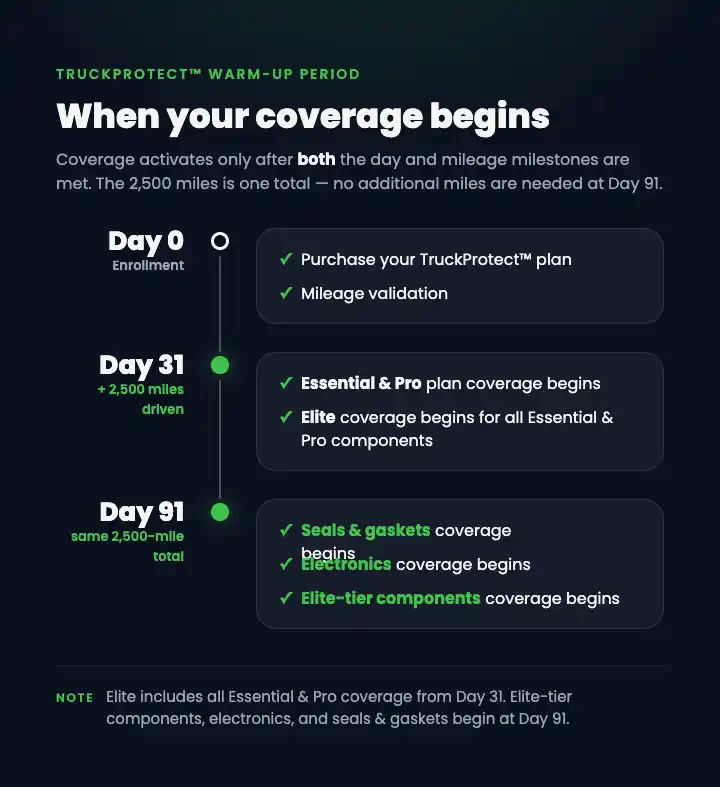
Seals & gasket coverage †
Electronics coverage
Total loss recovery
Towing reimbursement
x
FinalStretch
x
Extended repair benefits
Engine
Transmission
Driven Axles (Differentials)
No term or mileage limits
No long-term contract
Seals & gasket coverage †
Electronics coverage
Total loss recovery
Towing reimbursement
FinalStretch
x
Extended repair benefits
Engine
Transmission
Driven Axles (Differentials
Exhaust (Turbo & Aftertreatment)
•Fuel Systems
No term or mileage limits
No long-term contract
Seals & gasket coverage †
Electronics coverage
Total loss recovery
Towing reimbursement
FinalStretch
Extended repair benefits
•Engine •Transmission •Driven Axle (differential) •Exhaust (Turbo & Aftertreatment) •Fuel •HVAC •Brakes •Steering •Suspension •Drive Shafts •Charging •Cranking •Ignition •Air Intake •Cooling •Horns •PTO systems
As well as systems for supplemental information devices, general accessories, and electrical accessories


Our extensive TruckProtect™ Plans offer something for everyone. Discover which plan best suits your needs by exploring the number of parts covered for each vehicle system. Compare the Essential Plan’s basic protection, the Pro Plan’s comprehensive coverage, and the Elite Plan’s ultimate protection to find the perfect fit for you.
Essential
Pro
Elite
Total Parts
Total Parts
Total Parts
Engine
440
466
548
Transmission
1195
1195
1225
Driven Axels (Differential(s))
298
298
346
Exhaust (Turbo/After Ttreatment)
-
351
351
Fuel
-
321
321
HVAC
-
-
440
Brakes
-
-
60
Steering
-
-
211
Suspension
-
-
51
Drive Shafts
-
-
39
Charging
-
-
55
Cranking
-
-
89
Ignition
-
-
42
Suplemental Info devices
-
-
21
Air Intake
-
-
42
Cooling
-
-
181
General Acessories
-
-
29
Electrical Accessories
-
-
33
Horns
-
-
33
PTO
-
-
100
Instruments, gauges, warning, shutdown devices & meters
-
-
212
Hydraulic (additional fee)
Not available
Not available
224
TOTAL PARTS
1933
2631
4428
Our extensive TruckProtect™ Plans offer something for everyone. Discover which plan best suits your needs by exploring the number of parts covered for each vehicle system. Compare the Essential Plan’s basic protection, the Pro Plan’s comprehensive coverage, and the Elite Plan’s ultimate protection to find the perfect fit for you.
Essential
Parts
Pro
Parts
Elite
Parts
Engine
440
466
548
Transmission
1195
1195
1225
Driven Axles
298
298
346
Exhaust (Turbo/AT)
-
351
351
Fuel
-
321
321
HVAC
-
-
440
Brakes
-
-
60
Steering
-
-
211
Suspension
-
-
51
Drive Shafts
-
-
39
Charging
-
-
55
Cranking
-
-
89
Ignition
-
-
42
Supplemental Info devices
-
-
21
Air Intake
-
-
42
Cooling
-
-
181
General Accesories
-
-
29
Electrical Accessories
-
-
33
Horns
-
-
33
PTO
-
-
100
Instruments, gauges, warning, shutdown devices & meters
-
-
212
Hydraulics (additional fee)
Not Available
Not Available
224
Total
Parts
Total
Parts
Total
Parts
1933
2631
4428
Information subject to change.
View our TruckProtect™ Coverage Appendix for full details.
View Appendix >

 members@truckclub.com(818) 698-7825(818) MY-TRUCK
TruckClub Group Inc.
Offices:
1763 Columbia Rd NW
Suite 213
Washington, DC, 20009


