Tires are the second biggest operating expense on most trucks after fuel, and they are the one line item almost entirely in your control. A full set of 18 tires on a tractor-trailer can represent somewhere between $5,000 and $9,000 depending on brand and position, and how long that set lasts depends less on the tire than on the driver's habits around pressure, inspection, and alignment.
Tires also decide a lot beyond cost. They are among the most common causes of roadside breakdowns, a frequent out-of-service violation at inspections, and a meaningful factor in fuel economy. A truck running tires 15 psi low burns more fuel on every mile and gives up thousands of miles of tread life without the driver noticing.
This guide covers how to set and check pressure properly, how to read wear patterns and find what is causing them, what the legal tread depth limits are, how rotation and matching extend life, and how to decide when a tire is done. It is written for owner-operators and small fleets who buy their own rubber.
Why tire maintenance matters more than most drivers think
Tire problems rarely announce themselves. A slow leak from a nail picked up in a yard can run for days before the tire overheats and comes apart at highway speed. A misaligned axle can chew through a steer tire in a fraction of its normal life while the truck tracks straight enough that nobody questions it.
Tires are also a leading source of roadside service calls, and a roadside tire change on the shoulder of an interstate commonly runs several hundred dollars before the cost of the tire itself. Add lost drive time and a missed delivery window, and one neglected tire can cost more than a year of careful inspections. Tire failures show up near the top of the list in our look at the most common semi truck breakdowns, and most of them trace back to pressure or wear that was visible days earlier.
There is a compliance angle too. Tire violations carry heavy weight in the vehicle maintenance category of CSA scoring, and a tire below legal tread depth or with exposed cord is grounds for an out-of-service order on the spot.
Semi truck tire pressure: getting it right
Pressure is the foundation of everything else. Load capacity, contact patch, heat buildup, and wear pattern all depend on it, and a surprising number of drivers either guess or rely on the number stamped on the sidewall, which is a maximum rather than a recommendation.
What the correct tire pressure actually is
The right pressure depends on the load each axle carries, and tire manufacturers publish load and inflation tables that match pressure to axle weight. In practice, many steer tires on a loaded tractor run in the range of 105 to 120 psi, drive tires around 95 to 110 psi, and trailer tires somewhere similar, but those are starting points rather than rules. Pull the table for your tire size and set pressure for the loads you actually carry.
Running duals at mismatched pressures is one of the most costly mistakes. When one tire in a dual pair is lower than the other, the taller tire carries more of the load and the shorter one scrubs, and a large enough gap can cause the underinflated tire to fail outright.
Checking pressure the right way
Check tires cold, meaning before the truck has run or after it has sat for a few hours, because pressure climbs as tires heat up and a hot reading can mask a tire that is 10 psi low. Use a calibrated gauge rather than a thumper. A thumper can tell you a tire is flat, but it cannot tell you a tire is 85 psi when it should be 105, and that difference is where tread life goes to die. Check all 18 positions, including the inside duals that are easy to skip.
The cost of running underinflated
An underinflated tire flexes more, runs hotter, and wears the shoulders faster than the center. Tires run meaningfully below their correct pressure lose a significant share of their tread life and add to fuel consumption. On a truck that burns 20,000 gallons a year, even a small increase in rolling resistance adds up to real money at the pump. Our guide on fuel efficiency tips for commercial trucks covers the other side of that equation.
Reading semi truck tire wear patterns
Tires tell you what is wrong with the truck if you know how to read them. Every wear pattern points to a cause.
Center and shoulder wear
Tread worn down the middle while the shoulders stay tall means the tire has been overinflated for its load, so only the center rides on the road. Wear on both shoulders with a taller center means underinflation, which lets the tire flatten out and carry the load on its edges. Both are pressure problems and both are fixable with a gauge and the load tables.
One-sided wear and feathering
Wear concentrated on one shoulder of a steer tire typically points to an alignment issue, often camber or a bent component. Feathering, where the tread blocks develop a sawtooth edge you can feel by running your hand across the tire in one direction and then the other, usually indicates a toe problem. Steer tires with either pattern need an alignment check before you replace them, or the new tires will wear the same way.
Cupping, scalloping, and diagonal wear
Cupping or scalloping, where the tread wears in a series of dips around the tire, generally points to worn shocks, loose wheel bearings, or a balance problem. Diagonal wear across trailer tires often traces to a misaligned trailer axle or a worn suspension component. Any time you see an unusual pattern, note it on your inspection and have the underlying suspension or alignment issue looked at. These are exactly the kinds of small items that get missed in a hurry, and our rundown of overlooked semi truck maintenance items covers several that show up first in tire wear.
Tread depth and the legal limits
Federal regulations set a minimum tread depth of 4/32 of an inch on steer tires and 2/32 of an inch on all other positions, measured in a major groove. Those are out-of-service thresholds, not recommendations. Many fleets pull steer tires well before 4/32 because wet-weather traction drops sharply as tread gets shallow.
Measure tread with a proper depth gauge at several points around the tire, because wear is rarely even. A tire that measures 6/32 on one side and 3/32 on the other is already in violation at its lowest point. Record the measurements so you can see how fast each position is wearing and plan replacements before you are forced into a roadside purchase.
Tire rotation, matching, and alignment
Rotating tires on a tractor-trailer is less routine than on a car, but it still pays. Drive tires often wear unevenly between the front and rear drive axles, and swapping them partway through their life evens things out. Steer tires that are ready to come off the front can often move to trailer positions and run thousands more miles.
Matching matters more than most drivers realize. Dual tires should be the same size, the same tread type, and close in overall diameter, because a taller tire drags its partner every rotation and both wear fast. When replacing one tire in a dual pair, pick a tire with similar remaining tread rather than pairing a brand-new tire with one that is half worn.
Alignment should be checked whenever you see irregular wear on the steers, after any suspension work, and on a regular schedule even without symptoms. A full alignment that includes the drive axles is worth the extra cost, since drive axle misalignment wears the steers even when the steer axle itself is fine.
When to replace semi truck tires
Replacement is a judgment call that balances tread, age, damage, and where the tire will be running. The goal is to pull tires on your terms, in a shop, rather than on the shoulder.
Tread depth triggers
A common practice is to replace steer tires somewhere in the range of 5/32 to 6/32 and drive or trailer tires around 3/32 to 4/32, leaving a margin above the legal minimum. If you run heavy winter weather or wet mountain routes, consider pulling earlier.
Age, damage, and sidewall condition
Tread depth is not the only trigger. Sidewall cracking, bulges, cuts that expose cord, and repairs in the shoulder or sidewall all mean the tire comes off regardless of tread. Age matters too: rubber hardens and cracks over time, and many fleets set a maximum service age in the range of six to ten years from the date code even if tread remains. Tires that have been run flat for any distance may have hidden internal damage and should be inspected by a tire shop before they go back into service.
Retreads versus new tires
Retreads are a legitimate way to cut tire cost, and well-made retreads on quality casings perform well in drive and trailer positions. Most operators run new tires on the steer axle and consider retreads elsewhere. The economics depend on casing quality, so protecting your casings with correct pressure directly affects what your tire program costs over the long run.
One thing worth knowing before you budget: tires are a wear item, and that puts them outside what any mechanical protection plan covers. A plan like TruckProtect is built for major component failures such as engine, transmission, and aftertreatment systems, which is where the five-figure surprises live, but it will not pay for a worn tire. Tires are a cost you control through maintenance, which is exactly why a disciplined inspection routine pays off.
Building a tire inspection routine
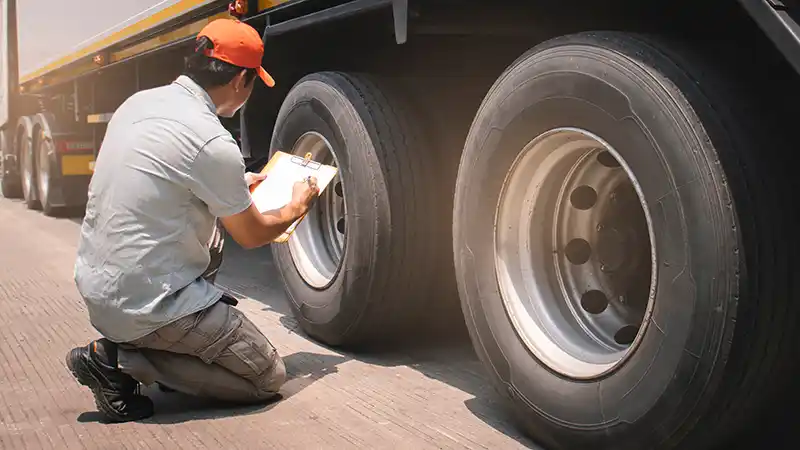
A practical routine looks like this. At every pre-trip, walk all 18 positions and look for obvious low tires, visible damage, objects in the tread, and anything hanging off the sidewall. Weekly, or before any long trip, gauge every tire cold and record the numbers. Monthly, measure tread depth at multiple points on each tire and note any irregular wear. Every service interval, have the shop check alignment, shocks, and wheel bearings and torque the lug nuts. Keep the records with the truck's maintenance file.
Fold this into your broader schedule rather than treating it as a separate chore. The preventative maintenance guide for semi trucks lays out how tires fit alongside oil, filters, brakes, and the rest.
Frequently asked questions
What tire pressure should a semi truck run?
It depends on the tire size and the load on each axle. Use the manufacturer's load and inflation table rather than the sidewall maximum. Many loaded tractors run steers around 105 to 120 psi and drives and trailers around 95 to 110 psi, but confirm against the table for your tires and weights.
How often should I check tire pressure on a semi?
Visually at every pre-trip, and with a gauge at least weekly and before long trips, always cold. A tire pressure monitoring system is a worthwhile upgrade for long-haul operators.
What is the legal minimum tread depth for commercial truck tires?
Federal rules require at least 4/32 of an inch on steer tires and 2/32 of an inch on all other tires, measured in a major tread groove. Most operators replace before reaching those limits for safety and traction reasons.
Can I use retreads on a semi truck?
Yes, retreads are widely used on drive and trailer positions. Most fleets avoid retreads on the steer axle and run new tires up front.
How long should semi truck tires last?
Steer tires often run in the range of 100,000 to 150,000 miles with good maintenance, and drive tires can go further depending on the application. Pressure, alignment, load, and driving style change those numbers a great deal, which is why two trucks on the same lane can see very different tire life.
Final thoughts
Tire maintenance comes down to a few habits done consistently: set pressure from the load tables, gauge cold and often, read the wear patterns and fix the cause, measure tread before the law does, and replace on your schedule instead of the road's. None of it is complicated. All of it adds up to thousands of dollars a year in tread life, fuel, and avoided breakdowns, and it keeps the truck rolling on days when a less careful operator is waiting on the shoulder.